
THE EXPERIMENTHARD NO TECHDRS90
WHAT HAPPENS WHEN YOU LEAVE THE DIGITAL WORLD AT HOME?
No live navigation. No continual messaging. No filming. No posting. No feed. The value is in being there: seeing it, hearing it and feeling it for yourself. That moment won’t happen again. You don’t need to film it or post it for it to matter.
THEN / NOWCOMPARISONVERIFIED SOURCES
BEFORE THE SMARTPHONE.
Leaving home routinely meant becoming partially unreachable. Before ubiquitous smartphones, people regularly travelled, met friends, attended events and returned home without carrying a permanently connected personal device.
97%
of young people aged 10–21 in a UK government survey had a smartphone.
96%
used social media — averaging just over 4 hours per day.
SOURCEUK GOVERNMENT / DSITCHILDREN'S WELLBEING ONLINE15 JULY 2026
Figures refer to the surveyed group, not every young person in Britain.
WHEN IT STARTSSMARTPHONE OWNERSHIP
AGE 10 → AGE 11
56% → 83%
Smartphone ownership rises sharply around the transition into secondary-school age.
SOURCEOFCOMUK CHILDREN'S MEDIA LIVES
DIGITAL TIMESCALE, NOT ALARM
≈ 1 DAY / WEEK
spent online — roughly the equivalent of one full day per week.
≈ 2 DAYS / WEEK
spent online — rising to around two days per week.
SOURCEOFCOMUK CHILDREN'S MEDIA LIVES
THE JOURNEY.
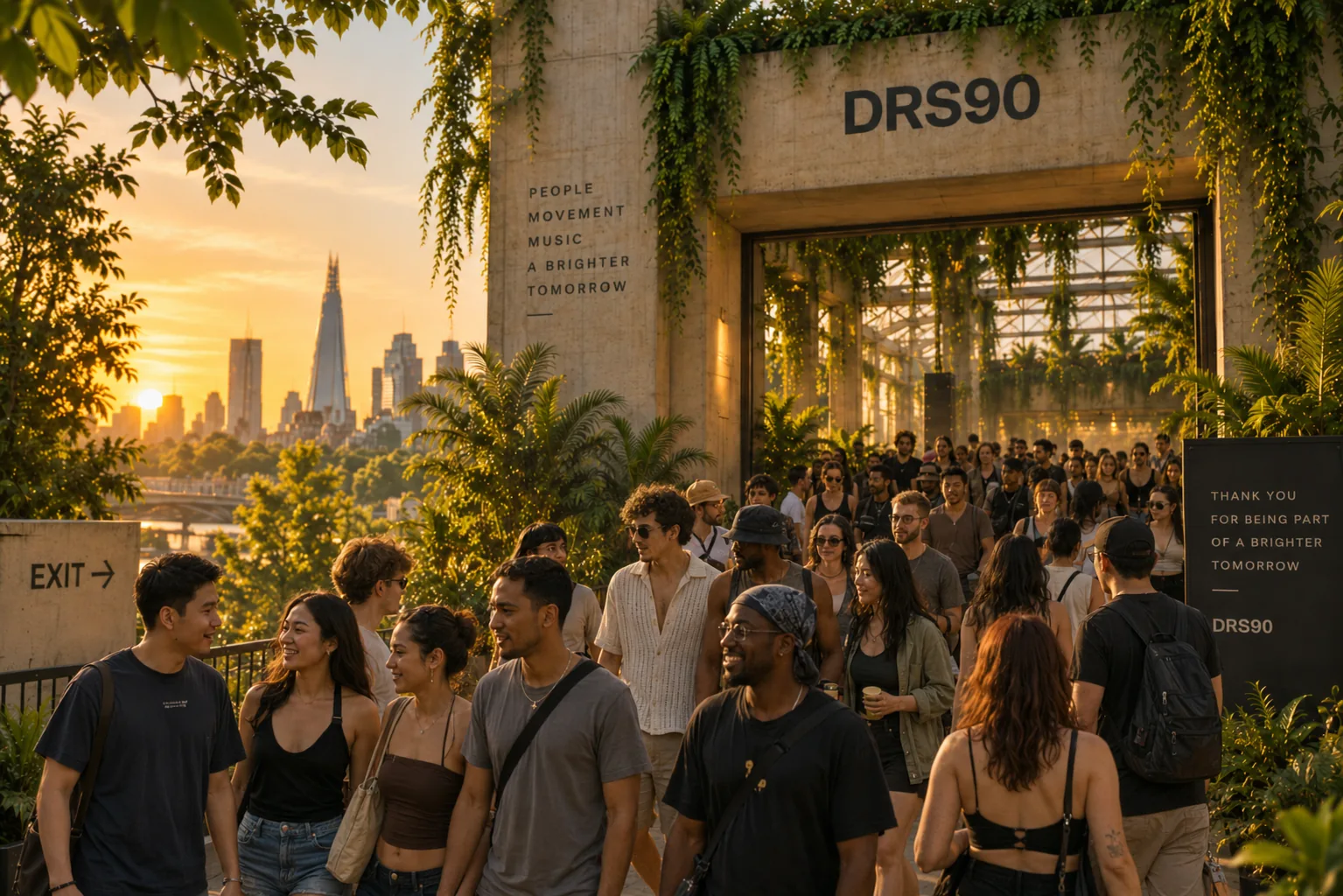
Hard No Tech is not putting a phone away while dancing. It starts at your front door and finishes when you get home.
HOMETRAVELMEETENTEREXPERIENCERETURN
01 / HOME
Leave the phone and connected personal technology behind.
02 / TRAVEL
Know where you are going.
Navigate without live smartphone guidance.
03 / MEET
Make a plan. Agree where to meet.
Arrive without continually updating one another.
04 / ENTER
Nobody in the attendee crowd is carrying a phone, camera, smartwatch or equivalent connected personal device.
05 / EXPERIENCE
No photography. No filming. No stories.
No posting. No notifications. No feed.
Music. Movement. People. Physical space.
06 / LEAVE
The event ends at a reasonable time.
Navigate your journey home without relying on a smartphone.
07 / HOME
Reconnect afterwards.
THE WHOLE JOURNEYNOT JUST THE ROOM
THE EXPERIENCE STARTS WHEN YOU LEAVE HOME.
Putting a phone in a pouch once you arrive is a different experience to deliberately leaving home without it. DRS90 is interested in the complete journey.
- Planning beforehand
- Travelling without constant digital guidance
- Meeting without continual messaging
- Being unreachable
- Experiencing an event without recording it
- Returning home independently
DRS90 makes no claims about psychological benefits. That is what the research is for.
OPEN QUESTIONSNO CONCLUSIONS
WE WANT TO FIND OUT.
Do people feel more immersed?
Do people interact differently when nobody has a phone?
Does behaviour change when nobody is filming?
What happens when checking a device is impossible?
How is an event remembered when very little personal footage exists?
How does being genuinely unavailable feel to people who rarely experience it?
Does the experience affect how people think about their own technology use?
DOES AVAILABILITY CHANGE THE EXPERIENCE?
We think it might. We want to find out.
RESEARCHWHAT WE ACTUALLY KNOW
THE BIG QUESTIONS ARE NOT SETTLED.
A 2026 UK government evidence review concluded that strong causal evidence about exactly how smartphones and social media affect young people's mental health and wellbeing remains limited.
That is why DRS90 wants to measure the experience rather than tell people in advance what they are supposed to feel.
SOURCEUK GOVERNMENT / DSITEVIDENCE REVIEW20 JANUARY 2026
RESEARCH NOTEPHOTOGRAPHY & MEMORY
Experimental research into photographing experiences has produced mixed findings. Some studies have found reduced memory for photographed objects, while other work has found photography can increase enjoyment in some circumstances.
DRS90 does not assume that removing cameras improves an experience. It creates the condition in which that question can be studied.
SOURCEEXPERIMENTAL RESEARCHPHOTOGRAPHY & MEMORY
RESEARCHOPEN INVITATION
RESEARCH WITH DRS90.
We want universities and independent researchers to study these experiences properly. No university partnership exists yet — this is an open invitation.
- /Pre-event measures
- /Structured observation
- /Post-event questionnaires and interviews
- /Longer-term follow-up
SOURCESEDITABLELINKS TO BE ADDED
UK Government / DSIT — Children's wellbeing online: What young people think about social media, safety and AI (published 15 July 2026)
Survey of young people's smartphone ownership, social media use and reported experiences. Figures refer to the surveyed group. Reported associations are not evidence of causation.
LINK / TO BE ADDED
Ofcom — Younger phone owners, the rise of AI, and consumption over creation: our latest look at UK children's media lives
UK regulator research into children's media use, smartphone ownership and time spent online.
LINK / TO BE ADDED
UK Government / DSIT — Understanding the impact of smartphones and social media on children and young people (published 20 January 2026)
Evidence review concluding that strong causal evidence on effects remains limited.
LINK / TO BE ADDED
Experimental research on photography, memory and enjoyment
Mixed findings: some studies report reduced memory for photographed objects; other work finds photography can increase enjoyment in some circumstances. Specific studies to be cited.
LINK / TO BE ADDED